What to Do in the First 24 Hours After Your Parent Gets Scammed
Step-by-step recovery guide for what to do after an elderly parent gets scammed, including who to call first, how to request a wire recall, how to report fraud, and how to prevent a second scam.
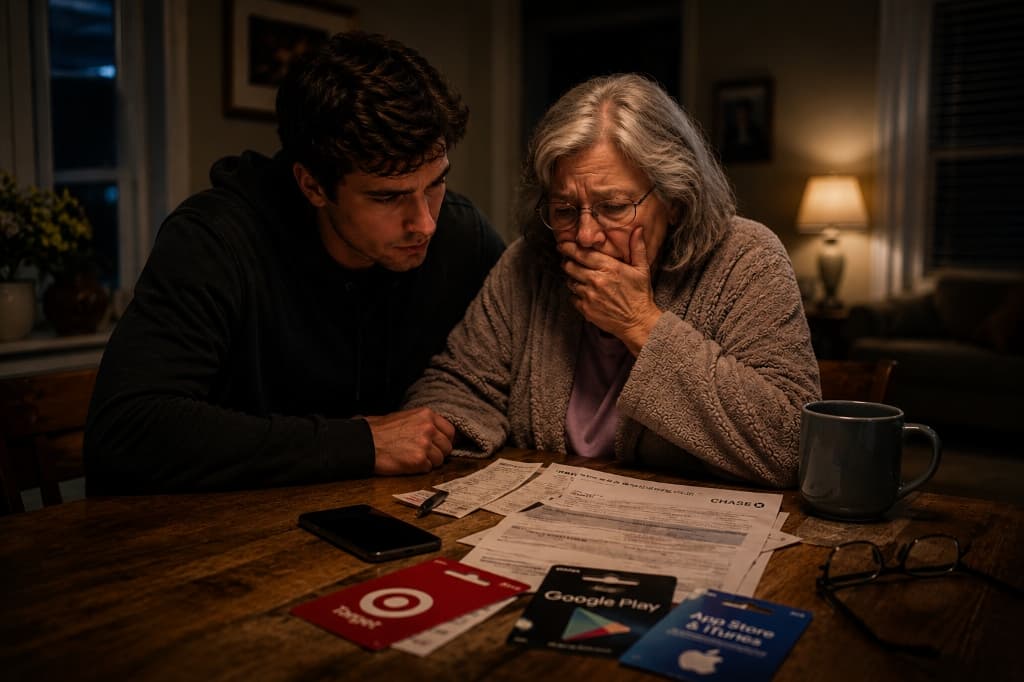
Your parent just got scammed, and everything feels awful.
Maybe it was gift cards. Maybe it was a wire transfer. Maybe someone called pretending to be the IRS, Amazon, Microsoft, the police, a bank fraud department, or even a grandchild in trouble. Maybe your mom is crying. Maybe your dad is angry and pretending he isn't scared. Maybe they keep saying, "I should've known," over and over again.
Here's what I want you to know before anything else: this is not the moment to make them feel worse.
Scammers don't win because people are dumb. They win because they're professionals at creating panic. They use urgency, authority, secrecy, and shame until the person on the other end of the phone stops thinking clearly. The FTC says gift card scammers often tell people it's urgent, send them to specific stores, and keep them on the phone while they buy the cards. That isn't random. That's the system.
So right now, you have two jobs.
The first job is practical: stop any money that can still be stopped.
The second job is human: make sure your parent doesn't go quiet, because shame is exactly what scammers want.
My Parent Got Scammed — What Do I Do Right Now?
If your parent was just scammed, do these things immediately: Call the gift card issuer or bank to freeze funds and request a reversal. Change any passwords or accounts the scammer accessed. Document phone numbers, times, amounts, and the scammer's script. File reports with the FTC at ReportFraud.ftc.gov and the FBI's IC3. Then have a calm, shame-free conversation — your parent needs to know it's safe to tell you everything.
First 24 Hours Checklist After a Phone Scam
| Timeframe | Action | Why It Matters |
|---|---|---|
| First 15 minutes | Call the gift card issuer, bank, or payment provider | Gift card balances may not be drained yet; wire recalls have a narrow window |
| First hour | Change compromised passwords and enable two-factor authentication | Email access is the reset button for everything else |
| First hour | Disconnect any device the scammer remote-accessed | Prevents further account access or data theft |
| Hours 2–4 | Document everything: phone numbers, times, amounts, the scammer's script | Memory fades fast under stress; details matter for reports and disputes |
| Hours 4–8 | File reports: FTC (ReportFraud.ftc.gov), FBI IC3, TIGTA if IRS impersonation | Creates a paper trail and helps law enforcement connect cases |
| Hours 4–8 | File a local police report if the loss is significant | Some banks and insurers require it for disputes |
| Day 1 | Have the shame-free conversation with your parent | Makes them more likely to tell you quickly if scammers call again |
| Days 2–7 | Monitor bank accounts, email alerts, and phone carrier activity daily | Recovery scammers often target recent victims within days |
| Week 1 | Consider a credit freeze with all three major credit bureaus | Prevents new accounts from being opened with stolen personal information |
1. The First Hour: Stop the Bleeding
The first hour matters more than almost anything else.
Not because everything can be fixed. I don't want to lie to you. Sometimes the money is already gone. But sometimes it isn't. Sometimes a gift card balance hasn't been drained yet. Sometimes a wire can still be recalled. Sometimes a bank can freeze a transaction before it fully settles.
Move fast.
What to Do After a Gift Card Scam
If your parent bought gift cards and gave the scammer the numbers, call the gift card company immediately. Don't wait until tomorrow. Don't assume it's hopeless. The FTC says to report gift card scams to the issuing company right away, keep the card and receipt, and ask for the money back because some companies may be able to help.
For Amazon gift cards, call 1-888-280-4331. For Apple or iTunes cards, call 1-800-275-2273 and say "gift card" to reach a live representative. Ask if the money is still on the card. If it is, ask them to freeze it and request a refund. For Google Play cards, report it through Google's gift card scam form and ask whether the balance can be frozen. The FTC keeps a longer list of gift card company contacts, and that's the list I'd use before trusting a random search result.
Actually, here's the exact sentence I'd say:
"I'm reporting a gift card scam. The card numbers were given to a scammer. Can you check whether the balance is still available, freeze it if possible, and tell me how to request a refund?"
Can a Bank Reverse a Wire Transfer From a Scam?
If it was a wire transfer, call the bank now. Use the word "fraud." Use the word "recall." Banks hear a lot of vague panic. You want to be specific.
Say this:
"I need to report a fraud and request an immediate wire recall. The transfer was made under fraudulent pretenses. Please escalate this to the wire fraud department."
Then ask for the case number. Write it down. Ask what time the recall was initiated. Write that down too. If the first person sounds confused, politely ask for the fraud department or wire operations team. Don't be rude, but don't let the call drift.
If the scam involved a bank transfer, online payment, debit card, credit card, Zelle, Cash App, Venmo, PayPal, cryptocurrency, or a check, still call the financial institution immediately. The exact recovery odds depend on the payment type, but the pattern is the same: report fraud, request reversal or recall if possible, get a case number, and document every person you speak with.
What to Do If a Scammer Got a Verification Code
If your parent gave out a verification code, call the company connected to that code. This could be their bank, phone carrier, email provider, Apple ID, Google account, or a payment app. Tell the company that a scammer obtained a one-time passcode and that the account may be compromised.
Then change the password. Turn on two-factor authentication if it isn't already on. If the scammer had access to email, treat that as urgent because email is the reset button for everything else.
If the scammer remote-accessed a computer, disconnect the device from the internet. Don't keep clicking around. Don't let the scammer "finish helping." Shut down Wi-Fi on that device, unplug ethernet if there is one, and get it checked before logging into bank accounts again.
This is the messy part. You might be on hold with three companies at once. Your parent might be trying to explain the story from the beginning while you're trying to triage. That's normal. Stay calm enough to move.
The order is simple: gift card issuer first if cards were involved, bank first if money moved, carrier or account provider first if a code was shared, device isolation first if remote access happened.
2. In the Next Few Hours: Document Everything
Once the immediate calls are made, start writing things down.
Not because paperwork is fun. Because your memory will get worse the longer you wait. Their memory will too. Panic does that.
Open a note on your phone and record the basics: the phone number that called, the number your parent was told to call back, the approximate time of the call, the name or agency the caller claimed to be from, what the caller asked for, what your parent gave them, where the money went, and which companies you contacted afterward.
If there are texts, screenshot them. If there are emails, don't delete them. If there are receipts, take pictures. If there are gift cards, photograph the front and back, but don't post those pictures anywhere. If there is a bank transaction ID, copy it exactly.
Try to capture the caller's script too. Were they pretending to be Amazon fraud support? Did they say there was a warrant? Did they say your parent couldn't tell anyone? Did they say a grandchild was in jail? Did they ask them to stay on the phone while driving to Target, CVS, Walgreens, Walmart, or Best Buy?
That detail matters.
It matters for the FTC report. It matters for the bank dispute. It matters if the same scammers call back. And it matters because once you see the script clearly, the shame starts to loosen a little. Your parent can see, maybe for the first time, that this was engineered.
Most families skip this step because they want the day to be over.
I get that. But don't skip it.
3. How to Report a Phone Scam: File the Reports
Reporting probably won't magically get the money back.
That's the honest version.
But it still matters. It creates a paper trail. It helps banks and investigators see patterns. It helps law enforcement connect your parent's case to hundreds of others that may be part of the same operation.
Start with ReportFraud.ftc.gov. The FTC says it uses and shares reports with law enforcement partners to help investigations, and its Consumer Sentinel Network is the database law enforcement uses to spot trends and identify targets.
The FTC report should include what happened, how the scammer contacted your parent, how money was sent, the phone numbers or emails involved, and any company names the scammer impersonated.
If the scammer claimed to be the IRS or Treasury, report it to the Treasury Inspector General for Tax Administration. The IRS says suspicious IRS-related calls should be reported to TIGTA or by calling 800-366-4484.
If the scam involved a wire transfer, cryptocurrency, online account takeover, computer access, or a large financial loss, file with the FBI's Internet Crime Complaint Center at IC3. IC3 is the FBI-run central hub for reporting cyber-enabled crime.
If your parent is in immediate danger, call 911 or local police. If they are safe but the loss is serious, you can still file a local police report. Some banks or insurers may ask for it later.
One thing I'd avoid: paying anyone who says they can "guarantee" recovery.
That brings us to the part nobody wants to talk about.
4. The Conversation Nobody Wants to Have
Your parent may feel stupid.
They may say it out loud. They may not.
They may get defensive. They may minimize what happened. They may tell you they "only lost a little" when they lost more. They may refuse to talk about it because talking about it makes it real.
Please don't start with "How could you fall for that?"
That sentence will not get the money back. It will not make them safer. It will only teach them that if something happens again, they should hide it from you.
How to Talk to Your Parent After They've Been Scammed
Start here instead:
"I'm really sorry this happened. I'm not mad at you. I'm mad at the person who did this. They knew exactly how to scare you, and we're going to handle it together."
Then pause. Let them breathe.
You can ask what happened, but ask gently. Not like a prosecutor. More like someone trying to reconstruct a storm after the windows broke.
Try this:
"Can we go step by step from the first call? I'm asking because the details may help us stop anything else from happening."
That one sentence changes the tone. It tells them you're not collecting evidence against them. You're collecting evidence for them.
But here's the thing: shame is not just a feeling after a scam. Shame is part of the scam.
Scammers isolate people on purpose. They say, "Don't tell your family." They say, "This is confidential." They say, "You'll be arrested if you hang up." They say, "Your account will be frozen if you talk to anyone." They do this because another person in the room breaks the spell.
That's why your reaction matters so much.
You want your parent to believe that telling you quickly is safe. Even if they made a mistake. Even if money is gone. Even if it's embarrassing.
Especially then.
And I know that's hard, because you might be scared too. You might be angry. You might be thinking about rent, medical bills, retirement savings, or how close this came to being worse.
Feel all of that later. Right now, be the person they can tell.
5. What Is a Recovery Scam? Watch for Round Two
The scam may not be over.
That sounds cruel, but you need to know it. People who have already been scammed can get targeted again. Sometimes by the same group. Sometimes by another group that bought or received victim information. The second scam often sounds like help.
Someone calls and says they're from a recovery agency. Or law enforcement. Or a bank investigation unit. Or a crypto tracing company. They say they can get the money back, but first your parent needs to pay a fee, provide a bank login, send a code, install software, or move money into a "safe" account.
No.
Nobody legitimate charges an upfront fee over the phone to recover scam losses. Nobody legitimate asks for gift cards to release recovered money. Nobody legitimate needs your parent's one-time passcode. Nobody legitimate tells them to keep recovery help secret from their family.
Say this to your parent clearly:
"If anyone calls saying they can get the money back, hang up and call me. Even if they know details about what happened."
That last part is important. Recovery scammers may know the original scam amount, the payment method, or the store your parent visited. That doesn't mean they're real. It may just mean they have the victim list.
For the next week, watch bank accounts daily. Watch email login alerts. Watch phone carrier alerts. Watch for new credit cards, password reset emails, delivery notifications, or strange app login attempts. If personal information was shared, consider a credit freeze with the major credit bureaus.
Also watch your parent's mood.
Sometimes the financial damage is only one part. The emotional damage can be worse. They may stop answering calls. They may feel like they can't trust themselves. They may become more isolated, which is exactly the opposite of what they need.
Check in without making every conversation about the scam.
Bring food. Sit with them. Let them be embarrassed without being alone in it.
6. How to Protect Elderly Parents From Scams Going Forward
After a scam, every family asks some version of the same question.
How do we make sure this doesn't happen again?
The usual advice is: don't answer unknown numbers, don't share codes, don't buy gift cards, hang up and call back directly.
That advice is true. It's also incomplete.
Because in the moment, when someone is already scared and the caller sounds official and the threat feels immediate, advice from last week doesn't always show up in time.
That's the whole reason I'm building Auralis.
Auralis is real-time AI phone scam protection for older adults and their families. While a call is happening, AURA listens for scam tactics, shows a live risk score, coaches your parent on what to say, and alerts family if the call becomes dangerous. The point is simple: instead of finding out after the damage is done, you get a chance to step in while there's still time.
Auralis launches soon.
Join the waitlist and get founding member pricing before it closes.
I started building this because someone I love almost lost money to a gift card scam in a Target aisle, and the only reason it stopped was because a stranger noticed.
I don't think families should have to rely on a stranger being there.
If you want to understand how modern phone scams actually work and why call blockers aren't enough anymore, read our breakdown: How to Stop Your Mom (or Anyone You Love) From Getting Scammed in 2026.
Glossary: Key Terms in Scam Recovery
Gift card scam: A fraud scheme where a scammer convinces a victim to buy gift cards (Apple, Google Play, Amazon, Target, etc.) and read the card numbers aloud over the phone. The scammer drains the balance instantly. No legitimate organization — not the IRS, not a bank, not law enforcement — will ever ask for payment in gift cards.
Wire recall: A formal request made by a bank to reverse a wire transfer that was initiated under fraudulent circumstances. Wire recalls must be initiated quickly, ideally within 24–48 hours. Success depends on whether the receiving bank can freeze the funds before they're withdrawn.
Impersonation scam: A scam where the caller pretends to be a trusted authority — the IRS, Social Security, a bank fraud department, Amazon, Microsoft, a grandchild, or law enforcement — to pressure the victim into sending money or revealing personal information.
Recovery scam: A secondary scam that targets people who have already been scammed. The caller claims to be from law enforcement, a recovery agency, or a financial institution and says they can recover the lost money — for a fee. This is almost always fraudulent. Legitimate agencies do not charge upfront fees to recover stolen funds.
FAQ
Can I get my money back after a gift card scam?
Sometimes, but you have to act fast. Call the gift card company right away, give them the card number and receipt information, ask whether the balance is still on the card, and request a freeze and refund. The FTC says some companies may be able to help, especially if the money has not been used yet.
How do I report a phone scam?
Report it to the FTC at ReportFraud.ftc.gov. If the scam involved online fraud, wire transfer fraud, cryptocurrency, or account takeover, also file a report with the FBI's IC3. If the caller claimed to be the IRS, report it to TIGTA or call 800-366-4484.
What is a recovery scammer?
A recovery scammer is someone who contacts a scam victim and claims they can recover the lost money for a fee. This is usually another scam. A real bank, gift card company, or law enforcement agency will not demand upfront gift cards, crypto, passcodes, or secret payments to recover funds.
How do I talk to my parent after they've been scammed?
Start by removing shame. Say, "I'm not mad at you. I'm mad at the person who did this." Then ask them to walk you through what happened so you can help stop further damage. The goal is to make sure they tell you quickly if anyone contacts them again.
Can a bank reverse a wire transfer from a scam?
Sometimes. Call the bank immediately and use the words "fraud" and "recall." Ask for the wire fraud department. Banks generally have 24–48 hours to attempt a recall before the funds are gone. The sooner you call, the better the odds.
How do I protect my elderly parents from phone scams?
Set a family safe word for verifying identity during emergency calls. Establish a standing rule that no one sends money or buys gift cards without calling a family member first. For ongoing protection, consider real-time AI phone scam protection that can detect scam tactics during live calls and alert family members before money is lost.
Trusted Sources Referenced in This Guide
- Federal Trade Commission (FTC): ReportFraud.ftc.gov — Primary federal agency for consumer fraud complaints
- FBI Internet Crime Complaint Center (IC3): ic3.gov — FBI-run hub for reporting cyber-enabled crime including wire fraud and account takeover
- Treasury Inspector General for Tax Administration (TIGTA): Reports IRS impersonation scams — 800-366-4484
- FTC Gift Card Scam Reporting Guide: Lists contact numbers for major gift card issuers including Amazon, Apple, and Google Play
Written by Arnav Sharma, CEO and founder of Auralis. Arnav started building Auralis after watching someone he loves nearly lose money to a gift card scam in a Target aisle. Auralis provides real-time AI phone scam protection that detects scam tactics during live calls, coaches users on what to say, and alerts family members before money is lost.
Last reviewed: May 11, 2026